




Std Pro - Custom
Ice Hockey Stick Size Chart
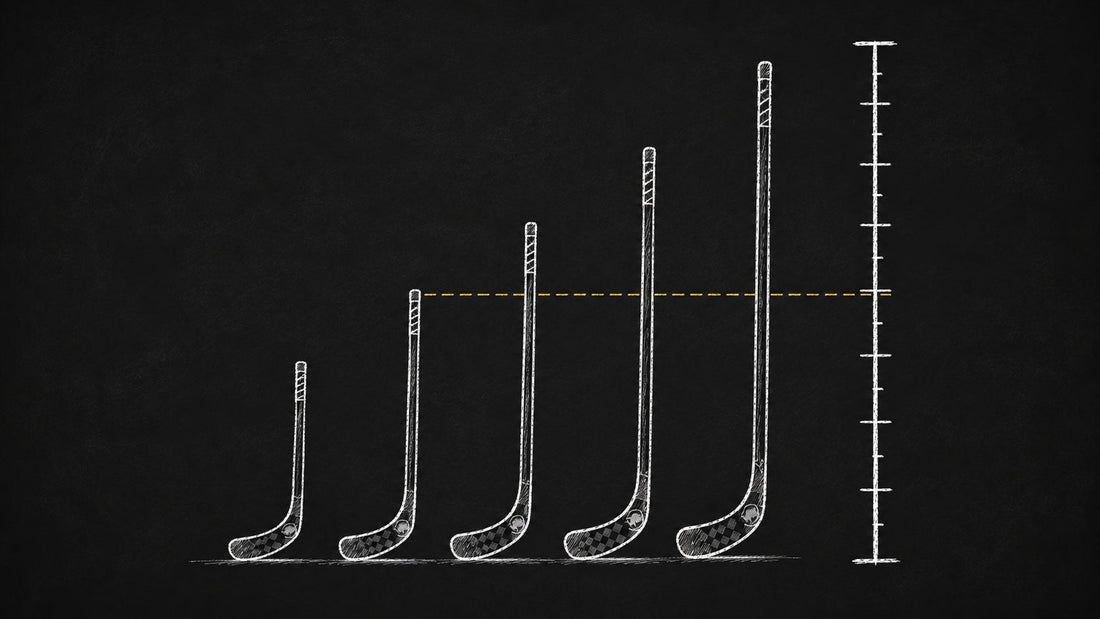
Ice Hockey Stick Size: Chart by Height, Weight and Age
This page is designed as a quick reference. Find your row, note down the category, length and flex – and you are done in half a minute. Detailed explanations follow below, in case you want to understand the reasoning behind the values.
One key note upfront to avoid most sizing mistakes: when it comes to length, your height is the determining factor; for flex, it is your weight – not your age. Age is included in the chart only as a rough guide, as children born in the same year can differ by up to 25 cm in height.
The reference chart

The categories overlap intentionally. If you fall between two rows, your height determines the category and your weight determines the flex – the two do not need to come from the same row. For example, a player 168 cm tall weighing 75 kg would use a Senior stick at 61–62″ with Flex 75.
Flex: Matched to Your Weight in Kilograms
The simplest reliable rule that works for us: body weight in kilograms ≈ Flex. If you weigh 78 kg, you start at Flex 75 or 80. If you weigh 62 kg, at Flex 60 or 65.
You may come across the American formula online – half your body weight in pounds. For a 78 kg player, that works out to roughly Flex 85, which is far too stiff for the vast majority of amateur players. A stick that is too stiff simply will not load up for shots; you will notice it when the puck barely travels even when you put full force into your swing.
Two adjustments to this starting value:

One step is 5 points for us. You should not deviate by more than one step – otherwise the basis no longer holds.
Which Flex Values Actually Exist Per Category
Many charts online recommend values that nobody makes. Flex 45, for example, does not exist. Below is the actual flex rating grid we offer:

Shaft width is the reason size categories exist in the first place. A Junior shaft is not only shorter and softer, but also thinner – otherwise a child cannot grip the shaft properly. Conversely, a Junior shaft feels too thin in an adult’s hand, even if its length and flex rating seem correct on paper.
How to Measure Stick Length
Stand up in trainers, hold the stick upright next to you with the blade tip on the floor. The top end of the shaft should sit between your chin and nose.
- Closer to the chin – more control in puck handling, a better position at face-offs, a lower stance.
- Closer to the nose – more reach and more leverage on the slap shot. Typical for defensemen.
On skates everything shifts up by about 5 cm: the stick should reach roughly to your chin. Both rules describe the same total length – one with skates on, one without.
Stick Length by Height
For more precision than the category chart above, here are lengths broken down into 5 cm increments. "Chin" is the shorter, control-oriented option, "nose" is the longer option:

Important note: There are two standard measurement methods.
This is the most common pitfall when buying sticks online. Two manufacturers can list the same stick as "63 inches" and "58 inches", and both can be correct.

All figures on this page refer to total length – the full measurement from blade tip to shaft end, which you can verify at home by holding the stick next to your chin. If you see a number that is around 5 inches shorter than expected, it almost certainly refers to shaft length only. If in doubt, please reach out to us – a quick email will save you from receiving an unusable stick.
How Cutting and Extending Affects Flex
Stick length can be adjusted, but not without consequences. A stick that has been cut down becomes stiffer, and an extended one becomes softer.

Example: You order Flex 75 and cut 5 cm off the shaft. This effectively plays like a Flex 80 stick. If you know you will be cutting the stick down, order the next softer flex rating from the start. More details are available in our guide to cutting and extending hockey sticks.
Kids: The Three Most Common Sizing Mistakes
- Buying too long to "grow into". An overlong stick forces a child into an upright posture and causes puck handling to drift out in front of the body. Additionally, the flex effectively becomes softer – a Flex 40 stick that is too long plays like a Flex 30. It is better to buy the correct size and replace it after the season.
- Choosing size by age instead of height. Two ten-year-olds can be 135 cm and 158 cm tall. Size category always follows height, never year of birth.
- Ignoring flex. For adults, a slightly mismatched flex is a matter of preference; for children it is not. A 35 kg child cannot bend a Flex 70 shaft and will never learn to properly load the stick.
More guidance is available in our parents' guide to kids' ice hockey sticks.
What You Have Now – And What Is Still Missing
Category, length and flex are the three core factors that determine fit. Two decisions remain, and these come down to personal preference, not objective measurement: blade pattern and kick point. If you are unsure about both, choose P92 or P28 with a mid kick point – this is a universally reliable setup.
You can put it all together in the configurator: size, flex, length, blade and grip in one go. If you would rather ask someone, write to us – we will work it out for you before you order.
Choosing the Right Hockey Stick Weight
Hockey Stick Weight – What Really Matters
The weight of a hockey stick has a direct impact on your on-ice performance: control, shot power, stickhandling, and stability all depend on how heavy your stick is. Many players choose the wrong weight—often because they prioritize brand name over performance.
In this guide, we break down which weight matches your playing style and what key factors you should consider.
Light, Medium or Heavy – What Fits You?

Real-World Comparison – Hockey Stick Weights on the Market (2023 to Present)
 Fun Fact: Color Affects Weight!
A colored paint finish adds around 10 g to your stick. Not much—but if every gram counts, you might want to think twice before opting for a full-color finish.
That’s why most top-tier sticks feature a minimalist design.
Which Weight Class Should You Choose?
✔ You’re a technical player and love puck control? → 325–350 g
✔ You want balance and all-round performance? → 350–375 g
✔ You play physical and need stability? → 375–400 g
✔ You mainly want extra durability? → 425 g+
Our Tip
Test, compare, and choose based on your playing style—not brand hype. At SoyuzHockey, weight is not a standalone configurable option—it is defined by the model: ARCANE, AURORA and RAPID come in at approx. 365 g; HIT GRIT, MASTER FRST and CLASSIC SPR at approx. 375 g; and the STD PRO at approx. 400 g. Simply pick the model that suits your game, and the weight comes with it.
The Ultimate Ice Hockey Stick Guide: Flex, Weight, Blade Curve & Kick Point Explained
Which Hockey Stick Is Really Right for You?
Flex, weight, blade or kick point – choosing the right hockey stick determines your shot power, control and feel. In this comprehensive hockey stick guide, we show you step by step how to find the perfect stick for your level, playing style and body weight – including tables, practical tips and videos.
The right hockey stick – briefly explained
The right hockey stick depends primarily on body weight, playing style and position. As a rule of thumb: body weight in kilograms ≈ Flex. Hybrid Kick suits all-rounders, Low Kick is for quick-release shots, and Mid Kick delivers maximum shot power.
- 1. Weight – What is ideal for you?
- 2. Flex – How do you choose the right flex?
- 3. Blade / Curve – Which curve fits your playing style?
- 4. Kick points – Which kick point optimizes your shot?
- 5. Grip – Which grip gives you better control?
- 6. Material & stability – What material suits your needs?
1. Weight – What is ideal for you?
➡️ to the detailed weight guide for hockey sticksThe weight of a hockey stick plays a decisive role, as it directly affects your playing style and performance on the ice. A light stick can improve your speed and agility, while a heavier stick offers stability and a solid feel on shots and stick checks.
1.1 How do you choose the right hockey stick weight?
A very light stick weighing around 350g is ideal for players who do a lot of stickhandling and prefer quick movements. These sticks let you control the puck efficiently and make precise passes or shots. However, an extremely light stick can be less robust and offer less stability on stick checks or hard shots (e.g. one-timers). The lightest sticks on the market also come with the highest price tag. The lightest ones are usually also the most expensive sticks.
Medium-weight sticks, roughly between 350 g and 430 g, offer a balanced mix of agility and stability. This variant is especially popular with most players, as it ensures flexibility in various game situations.
Heavier sticks over 430 g are used more by players who have a lot of physical contact and want greater stability. These sticks often offer greater durability and are designed for powerful shots and passes. Heavy hockey sticks weighing more than 430g are, on the other hand, very affordable.
1.2 Our video comparison: weight and brands
In our video we compare the weights of various stick models:
-
CCM Ribcor Trigger 9 Pro: Weighs 370 g and belongs to the middle weight classes.
-
Bauer Proto R White Edition: At 345 g, it is among the lighter models.
-
SoyuzHockey Custom-Sticks: The weight depends on the chosen model: for the SR models it ranges between 365g and 400g (measured at 169 cm) – from lighter models like ARCANE, AURORA or RAPID (365g) through HIT GRIT, MASTER FRST and CLASSIC SPR (375g) up to the STD PRO (400g).
- Conclusion: Currently, top models from various brands like CCM, Bauer, Sherwood, True, etc. are between 340 and 400g. It has been that way for several years. The bottom line is that even though creative new names keep being invented for the latest models, the weight often stays within this range. To make a more informed choice, look at the facts rather than brands or model names. Stick weights are published online. Do your own research and find out how heavy your current stick is or how heavy the stick you plan to buy is.
1.3 Influence of colours on weight
Did you know that the colour of your stick affects the weight? A coloured paint job adds about 10g to the total weight of the stick. That's not much, but it can make a difference in situations where every gram counts.
Fact: Colour adds up to 15 grams to the weight of a hockey stick. That's why most designs (regardless of brand) are mostly carbon patterns.
1.4 What to consider regarding stick weight
Ultimately, the choice of the ideal weight depends on your playing style, your position and your personal preferences. Remember: a light stick can improve your agility, while a heavier stick can give you more stability. Try different weights and find out which one you feel most comfortable with!
2. How do you choose the right stick flex?
Short answer: As a rule of thumb: your body weight in kilograms roughly equals your ideal flex value. A player weighing 75 kg should start with a 70–75 flex.
➡️ to the detailed flex guide (flex chart by weight + Flex Finder)

The flex of your hockey stick directly affects how the stick behaves on shots and passes. It describes the flexibility of the shaft and is indicated by a number that refers to the force in pounds needed to bend the stick by 2.5 cm (1 inch). The higher the number, the stiffer the stick. An optimal flex can significantly improve your shot power, precision and control.
2.1 What does the flex value mean?
A stick with a flex of 77 needs 77 pounds (approx. 35 kg) to be bent by 2.5 cm. A higher flex value (e.g. 85 or 100) indicates that the stick is less flexible, which requires more force to bend it. A lower flex value (e.g. 55 or 65) means the shaft bends more easily and is suitable for players with less body weight or less strength.
2.2 Which flex suits you?
A simple rule for choosing the right flex is to use your body weight as a guide:
- Flex number in kg: Your weight in kilograms roughly equals the optimal flex.
- Flex number in pounds: Half of your weight in pounds gives you a good guideline.
Examples:
- A player weighing 75 kg can choose a stick with a 75 flex.
- A player weighing 150 pounds could use a stick with a 75 flex.
Hockey stick flex table
The following table shows which flex value is recommended depending on body weight
and height.

2.3 Consider playing style and position
Your playing style also influences the choice of flex:
- Stickhandlers and passers: A lower flex (e.g. 65–75) offers more control and makes handling easier. Perfect for players who carry the puck often or prefer quick movements.
Example: Connor Bedard uses a stick with a 70 flex
- Shooters and players with powerful shots: Players who often shoot from the blue line or take one-timers benefit from a higher flex (e.g. 85–100), as it transfers more energy to the puck.
Example: Cale Makar uses a stick with a 95 flex
2.4 How does stick length affect the flex?
Note that cutting your stick increases the flex value. Every centimetre cut off makes the shaft stiffer, so an 85 flex can feel like a 90 flex after cutting. So plan at the time of purchase how much you want to cut off the shaft.
Example: If you cut 5 cm off a 67" (170cm) stick with a 75 flex, it will then have an 80 flex at a length of 65" (165cm).
2.5 What you should know about flex
Choosing the right flex is crucial to getting the most out of your stick. A stick that is too stiff requires more force and impairs precision, while a stick that is too soft generates less shot power. Test different flex options to find the right balance for your style.
3. The right curve for your game
➡️ to the detailed curve guide (images of all variants and brand comparison table)Choosing the right blade pattern (often referred to simply as "curve") is decisive for your success on the ice. The blade directly affects how you control, pass and shoot the puck. Players have different preferences, and the choice of blade should match your individual playing style.

3.1 How does the blade affect your game?
The blade is the lower end of the stick, attached to the shaft, that makes contact with the puck. The shape, length and angle of the blade determine how the puck is guided and how you execute shots and passes. Each blade has specific characteristics that offer different advantages, depending on whether you want to make precise passes, take powerful shots or control the puck.
3.2 The most important features of a blade
Curve:
The curve of a blade indicates how strongly it is bent.
- Deep curve: Perfect for toe-release/toe-drag shots with a high trajectory and better puck control (toe-drags)

Example: S28 curve
- Flat curve: Offers more precision for passes and shots.

Example: S88 curve
Angle (Lie):
The angle between the blade and the ice affects how the stick picks up the puck. Players with an upright posture often prefer a higher angle, while deeply crouched players choose a flatter angle.

➡️ to the hockey stick Lie guide
Length:
- Short blades: Ideal for puck control and tight dribbling.

Example of a short curve S14
- Long blades: Offer more reach and are suitable for defensive players.

Example of a long curve S02
Toe shape:
- Round toe (common nowadays): Good for precise stickhandling.

Example of a round curve toe S92
- Square toe (old school): Better suited for powerful shots.

Example of a square curve toe S02
3.3 How do I choose the right blade?
The right blade depends on your playing style and your goals on the ice:
- Playmaker: Choose a blade with a medium curve for precise passes and good puck control.

Example: S88 – playmakers like Patrick Kane play this curve.
- Sniper: Go for a strongly curved blade to enable powerful shots with a high trajectory.

Example: S28 - the most popular sniper curve at the moment. David Pastrnak regularly scores 40+ goals in the NHL with it.
- All-rounder: A hybrid curve gives you the flexibility to make both precise passes and powerful shots.

Example: S90TM - becoming increasingly popular. A mix of S92 (playmaker) and S28 (sniper).
3.4 The most common blade profiles and their advantages
Best-selling blades: S92, S28, S90TM

Here are some examples of typical hockey stick blade profiles:

Heel Curve
The curve starts close to the shaft.
Ideal for precise passes and hard slapshots – especially popular with defenders.


Toe Curve
The curve in the front area. Perfect for quick releases, dangles and snapshots – ideal for offensive players.

3.5 Why should I try different blades?
The choice of blade is very individual. Even small differences in shape or curve can change your feel for the game. Try different blades to find out which one best suits your style.
Our recommendation:
At SoyuzHockey we offer a wide selection of blades and curves tailored to the needs of every player. Whether Mid, Toe or Heel Curve – we help you find the perfect blade for your game.
4. Kick points – Optimising shot energy

The kick point of a hockey stick is one of the most decisive characteristics when it comes to shot performance. It describes the area of the stick where the shaft flexes most during the shot. The kick point affects how the stick absorbs and releases the energy of the shot, and thus also shot power and accuracy.
4.1 What is the kick point?
The kick point of a hockey stick is the area of the shaft where the stick bends most during a shot. The stick is designed so that the kick point is set at a specific spot on the shaft, while the material around this point is reinforced to ensure that the stick flexes exactly at this spot. This enables efficient energy transfer during the shot.
4.2 The different kick points in detail
Low kick point:
A low kick point is located closer to the blade of the stick and ensures that the stick flexes faster and with less effort on shots. Players who prefer quick shots or wrist shots benefit from a low kick point. The stick releases energy faster and ensures precise shots at higher speed, without the player having to use much force.

Mid kick point:
A mid kick point is located in the middle of the stick and offers a balanced combination of precision and shot power. Players who take both slapshots and wrist shots benefit from this kick point, as it is suitable for versatile shooting techniques. The mid kick point enables even energy transfer and ensures a good balance between control and power.

High kick point:
A high kick point is located higher up on the stick and is ideal for players who focus on slapshots. This kick point stores more energy and releases it with maximum force when the stick flexes fully during a powerful slapshot. Players who regularly shoot from the blue line or want to achieve high shot speeds often choose a high kick point.

Hybrid kick point:
A hybrid kick point combines elements of low and high kick points to enable a more flexible shooting technique. This is ideal for players who need both precise wrist shots and powerful slapshots. A hybrid kick point ensures more versatility and is well suited to different playing styles.

4.3 How does the kick point affect your playing style?
The choice of the right kick point depends on your playing style and your preferred shooting techniques. Here are some general guidelines:
- Players with quick wrist shots: A low kick point ensures fast bending of the stick and a precise release of energy.
NHL players who use a low-kick stick: Connor Bedard, Quinn Hughes, Mitch Marner
Low-kick hockey stick models: CCM Ribcor, Bauer Vapor, Warrior Covert, True Hzrdus
- Players who take both slapshots and wrist shots: A mid kick point is ideal for balanced performance.
NHL players who use a mid-kick stick: Nathan MacKinnon, Cale Makar, Lane Hutson
Mid-kick hockey stick models: CCM Tacks, Bauer Nexus, Warrior Novium, True Catalyst
- Players who prefer powerful slapshots: A high kick point offers maximum shot power and precision for shots from a distance.
- Players who need a combination of quick and powerful shots: A hybrid kick point offers the flexibility to master both types of shots.
NHL players who use a hybrid-kick stick: Macklin Celebrini, Connor McDavid
Hybrid-kick hockey stick models: CCM Jetspeed, Bauer Pulse, Warrior Alpha, True Project
4.4 Why is the kick point so important?
The kick point is decisive for shot performance because it directly affects the way the stick flexes when shooting. The stick stores the energy of the shot and releases it through the kick point. An optimal kick point ensures that the stick works efficiently and powerfully, which increases shot speed and accuracy.
4.5 Conclusion – The perfect kick point for your playing style
Choosing the right kick point is an important factor when selecting a hockey stick. Depending on your playing style, shooting technique and preferences, you should choose the kick point that suits you best. Whether you prefer quick wrist shots, precise slapshots or a combination of both techniques, the right kick point helps you take your game to the next level.
5. Grip – For a secure feel on the stick
The grip of a hockey stick is more than just a design decision – it directly affects control and feel during the game. Choosing the right grip can make the difference between a secure, precise pass and a failed shot. There are various grip options that help players improve their performance by controlling the stick better while offering more comfort.

Spiral Grip on the SR 350g Hybrid Kick
5.1 What is the grip of a hockey stick?
The grip is the area of the stick where the player holds the stick. It can be made of rubber, plastic or other materials that provide a grippy surface. The grip ensures that the player can hold the stick securely in hand, without the stick slipping out during fast movements or contact. A suitable grip contributes not only to shooting technique, but also to the player's health, as it prevents the palms from slipping too much on the stick and creating unnecessary strain.
5.2 The different grip options in detail
There are many different types of grips, and each option offers different advantages, depending on the needs and preferences of the player. Here are the most common grip types used in the hockey world:
Tactile Grip:
A tactile grip offers a textured surface that is especially non-slip and gives the player improved control over the stick. This type of grip is especially popular with players who want a very direct and precise feel for the stick. The tactile grip is excellent for players who rely on puck control.
Spiral Grip:
A spiral grip offers a spiral-shaped structure that ensures ergonomic handling while providing grip at the same time. This type of grip is especially popular with players who need to rotate the stick quickly and precisely without losing control. The spiral grip offers a great combination of comfort and control.
Candy Cane Grip:
The Candy Cane Grip is characterised by a unique, twisted structure that makes the stick especially grippy. This type of grip is very pleasant in the hand and ensures a firm hold, even during fast movements and in intense game situations. The Candy Cane Grip is especially popular with players who want a very soft and pleasant feel in the hand.
Ribbed Grip:
A ribbed grip offers vertical ridges or bumps along the stick that increase grip and provide more hold. This structure gives players very good feedback when shooting and controlling the puck. The ribbed grip is especially useful for players who do a lot of stickhandling and need a secure, immediate grip on the stick.
Standard Grip:
A Standard Grip is the simple variant without additional structures or designs. This grip offers a solid, non-slip feel that is sufficient for many players. It is especially suitable for players who prefer a discreet but effective grip. The Standard Grip is very versatile and used by players of all styles.
No grip:
Some players choose a stick without grip to feel the natural feel of the stick. This variant offers pure, unaltered contact and is preferred above all by players who want minimalist handling of the stick. A stick without grip can, however, make control a bit more difficult, especially when your palms are sweaty.
5.3 How do you choose the right grip for your playing style?
The choice of the right grip depends heavily on your playing style and the specific demands you place on your stick:
- Players who do a lot of stickhandling or make fast movements: A tactile grip or spiral grip is ideal, as they ensure precise control.
- Players who value comfort and durability: The Candy Cane Grip or the ribbed grip offer maximum comfort and stable handling.
- Players who prefer a classic solution: The Standard Grip or the absence of a grip offer a simple and proven feel.
5.4 Why is the grip so important?
The grip of a hockey stick not only provides comfort, but also improves playing technique. A firm hold can help make shots more precise and passes faster and more controlled. Especially in high-pressure game situations, where speed and precision are decisive, the right grip helps to use the stick optimally.
5.5 Conclusion – The perfect grip for your style of play
The grip of your hockey stick is an essential factor for your performance on the ice. Choose the grip that best suits your playing style and preferences in order to maximise control and comfort. Whether you want to take quick wrist shots, improve puck control or simply enjoy the feel of a solid grip – the right choice of grip can make a real difference to your on-ice performance.
6. Material and stability – What's inside the stick?
From carbon to alternative materials: learn how the material of your stick affects its performance and durability. A video on this is in production and will be available here soon.
With our Stick Guide you can become a hockey stick expert and select your ideal stick with confidence. Use our videos, tips and tools to take your game to the next level!
7. Frequently asked questions about hockey sticks
Which flex is right for children?
For children: the flex should be significantly lower than for adults. As a rule, it is between 20 and 40, depending on body weight.
Is an expensive hockey stick automatically better?
Not necessarily. What matters is that flex, length and curve suit the player – not the price. Generally, the lighter the stick, the more expensive it is.
Which kick point is suitable for beginners?
Mid-Kick is ideal for beginners, as it is forgiving and versatile.
Which hockey stick is best for amateur players?
For amateur players, a balanced stick with Mid-Kick, a suitable flex and medium weight is ideal. What matters is that the flex suits the body weight.
How long does a hockey stick last?
Durability depends heavily on playing style, ice time and playing intensity. For professional players who train 1–2 sessions per day, a stick may last 1 month or less. Example: Nathan MacKinnon needs about 400 hockey sticks per year. Yes, that's right, 400 – it's not a typo. He revealed this in an interview. For players who use it little, a hockey stick can also last a good 1-2 years.
Learn more about our hockey sticks and their customisation options:
- Order your custom hockey stick here
- Follow us on Instagram
- Discover our TikTok page
More helpful stick guides:
- Hockeyrepairshop
- Spirit of Hockey
- ReXhockey
Our frequently asked questions (FAQ): https://www.soyuzhockey.com/pages/faq
SOYUZ Technology
A hockey stick is only as good as what's inside it. Every SOYUZ stick is developed entirely in-house and protected by our own patents – not a standard OEM profile that any brand can buy off the shelf. On this page we show you what makes the difference: the ARCHRING Dual-Loop structure, the AEROX Taper geometry and aerospace-grade T1100 carbon.

ARCHRING Dual-Loop Structure

At the heart of the SOYUZ top models ARCANE and RAPID is the ARCHRING Dual-Loop structure. Instead of a classic, angular shaft profile, SOYUZ relies on a double-ring geometry made of two round arches. This circular construction transfers force more evenly and distributes impact forces around the ring rather than at a single point – making the shaft significantly more resistant to damage.
The comparison that fits best is the Chinese composite bow: a short draw length, a high compression ratio – and therefore high recoil efficiency. That is exactly the principle behind the Dual-Loop geometry.
Why the round shape is decisive
- More even force distribution – the round structure spreads impact forces instead of concentrating them at the edges
- Higher breaking strength – fewer weak points means more durability in hard use
- More homogeneous shaft construction – the round geometry allows a more uniform material build-up along the entire shaft than an angular profile
- More efficient recoil – as with the composite bow, more of the stored energy returns into the shot
AEROX Taper Technology
The AEROX Taper is the shaft geometry built on top of the Dual-Loop structure – a complete in-house development by SOYUZ, not a standard profile. The geometry is designed to guide flex energy precisely: it channels the force directly toward the blade without energy being lost along the way in the shaft. The result is more efficient energy transfer and a shot that feels more controlled.
- Exclusive in-house development – engineered from the ground up, patent pending
- Precise energy guidance – flex energy travels directly into the puck instead of scattering
- Reduced vibration – the construction increases the amplitude of energy transfer while shortening the duration of vibration
T1100 – Carbon from Aerospace
In the top models ARCANE and RAPID, SOYUZ uses T1100 carbon fiber – a material originally developed for aerospace and correspondingly costly. T1100 belongs to the third generation of high-performance carbon fibers and achieves something long considered technically difficult: strength and stiffness at the highest level at the same time.

Where else T1100 is used

Delivery within two weeks
30-Days Warranty
Round-the-Clock Support
100% Secure and easy payment
Std Pro - Custom
If you have any questions, you are always welcome to contact us. We'll get back to you as soon as possible, within 24 hours on weekdays.
-
Shipping Information
Use this text to answer questions in as much detail as possible for your customers.
-
Customer Support
Use this text to answer questions in as much detail as possible for your customers.
-
FAQ’s
Use this text to answer questions in as much detail as possible for your customers.
-
Contact Us
Use this text to answer questions in as much detail as possible for your customers.