


Ice Hockey Stick Size Chart: by Height, Weight and Age
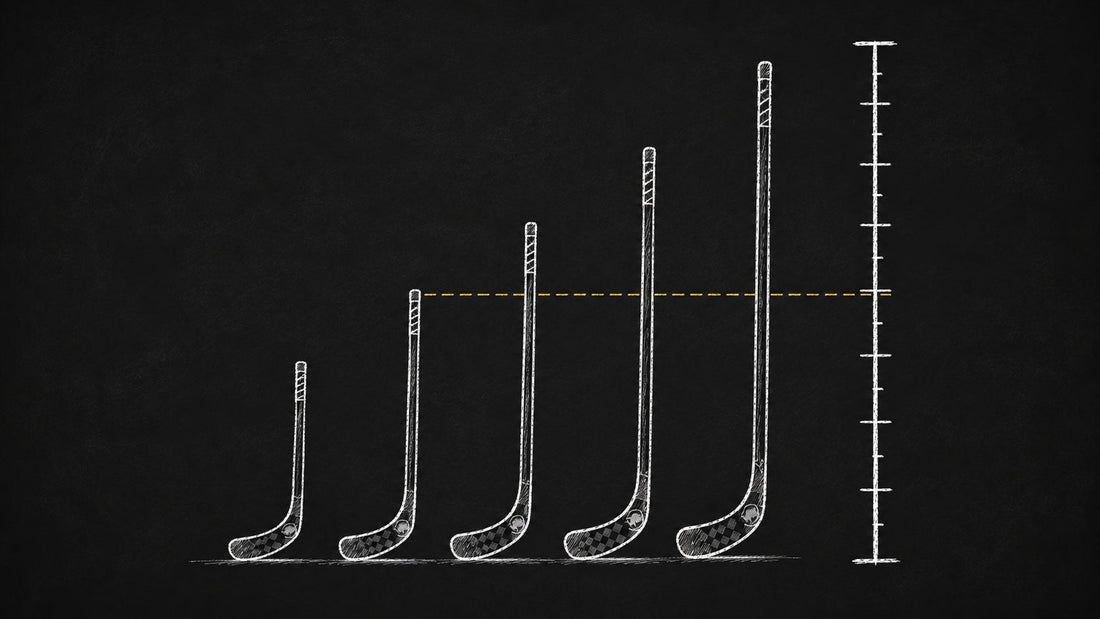
Ice Hockey Stick Size: Chart by Height, Weight and Age
This page is designed as a quick reference. Find your row, note down the category, length and flex – and you are done in half a minute. Detailed explanations follow below, in case you want to understand the reasoning behind the values.
One key note upfront to avoid most sizing mistakes: when it comes to length, your height is the determining factor; for flex, it is your weight – not your age. Age is included in the chart only as a rough guide, as children born in the same year can differ by up to 25 cm in height.
The reference chart

The categories overlap intentionally. If you fall between two rows, your height determines the category and your weight determines the flex – the two do not need to come from the same row. For example, a player 168 cm tall weighing 75 kg would use a Senior stick at 61–62″ with Flex 75.
Flex: Matched to Your Weight in Kilograms
The simplest reliable rule that works for us: body weight in kilograms ≈ Flex. If you weigh 78 kg, you start at Flex 75 or 80. If you weigh 62 kg, at Flex 60 or 65.
You may come across the American formula online – half your body weight in pounds. For a 78 kg player, that works out to roughly Flex 85, which is far too stiff for the vast majority of amateur players. A stick that is too stiff simply will not load up for shots; you will notice it when the puck barely travels even when you put full force into your swing.
Two adjustments to this starting value:

One step is 5 points for us. You should not deviate by more than one step – otherwise the basis no longer holds.
Which Flex Values Actually Exist Per Category
Many charts online recommend values that nobody makes. Flex 45, for example, does not exist. Below is the actual flex rating grid we offer:

Shaft width is the reason size categories exist in the first place. A Junior shaft is not only shorter and softer, but also thinner – otherwise a child cannot grip the shaft properly. Conversely, a Junior shaft feels too thin in an adult’s hand, even if its length and flex rating seem correct on paper.
How to Measure Stick Length
Stand up in trainers, hold the stick upright next to you with the blade tip on the floor. The top end of the shaft should sit between your chin and nose.
- Closer to the chin – more control in puck handling, a better position at face-offs, a lower stance.
- Closer to the nose – more reach and more leverage on the slap shot. Typical for defensemen.
On skates everything shifts up by about 5 cm: the stick should reach roughly to your chin. Both rules describe the same total length – one with skates on, one without.
Stick Length by Height
For more precision than the category chart above, here are lengths broken down into 5 cm increments. "Chin" is the shorter, control-oriented option, "nose" is the longer option:

Important note: There are two standard measurement methods.
This is the most common pitfall when buying sticks online. Two manufacturers can list the same stick as "63 inches" and "58 inches", and both can be correct.

All figures on this page refer to total length – the full measurement from blade tip to shaft end, which you can verify at home by holding the stick next to your chin. If you see a number that is around 5 inches shorter than expected, it almost certainly refers to shaft length only. If in doubt, please reach out to us – a quick email will save you from receiving an unusable stick.
How Cutting and Extending Affects Flex
Stick length can be adjusted, but not without consequences. A stick that has been cut down becomes stiffer, and an extended one becomes softer.

Example: You order Flex 75 and cut 5 cm off the shaft. This effectively plays like a Flex 80 stick. If you know you will be cutting the stick down, order the next softer flex rating from the start. More details are available in our guide to cutting and extending hockey sticks.
Kids: The Three Most Common Sizing Mistakes
- Buying too long to "grow into". An overlong stick forces a child into an upright posture and causes puck handling to drift out in front of the body. Additionally, the flex effectively becomes softer – a Flex 40 stick that is too long plays like a Flex 30. It is better to buy the correct size and replace it after the season.
- Choosing size by age instead of height. Two ten-year-olds can be 135 cm and 158 cm tall. Size category always follows height, never year of birth.
- Ignoring flex. For adults, a slightly mismatched flex is a matter of preference; for children it is not. A 35 kg child cannot bend a Flex 70 shaft and will never learn to properly load the stick.
More guidance is available in our parents' guide to kids' ice hockey sticks.
What You Have Now – And What Is Still Missing
Category, length and flex are the three core factors that determine fit. Two decisions remain, and these come down to personal preference, not objective measurement: blade pattern and kick point. If you are unsure about both, choose P92 or P28 with a mid kick point – this is a universally reliable setup.
You can put it all together in the configurator: size, flex, length, blade and grip in one go. If you would rather ask someone, write to us – we will work it out for you before you order.